Wondering, can pipe bursting fix a collapsed sewer line? Learn how this trenchless method works for severe damage and when it's the best solution. Contac...
How Does Pipe Bursting Work?
 When you’re facing a failing, collapsed, or root-infested sewer line, the thought of digging a massive trench across your lawn is daunting. Fortunately, modern technology offers a powerful, less invasive alternative. So, how does pipe bursting work? It’s a trenchless sewer replacement method that breaks apart your old, damaged pipe underground while simultaneously pulling a brand-new, seamless pipe into its place. This process avoids major excavation, saving your landscaping, driveway, and sanity.
What is Pipe Bursting? A Trenchless Revolution
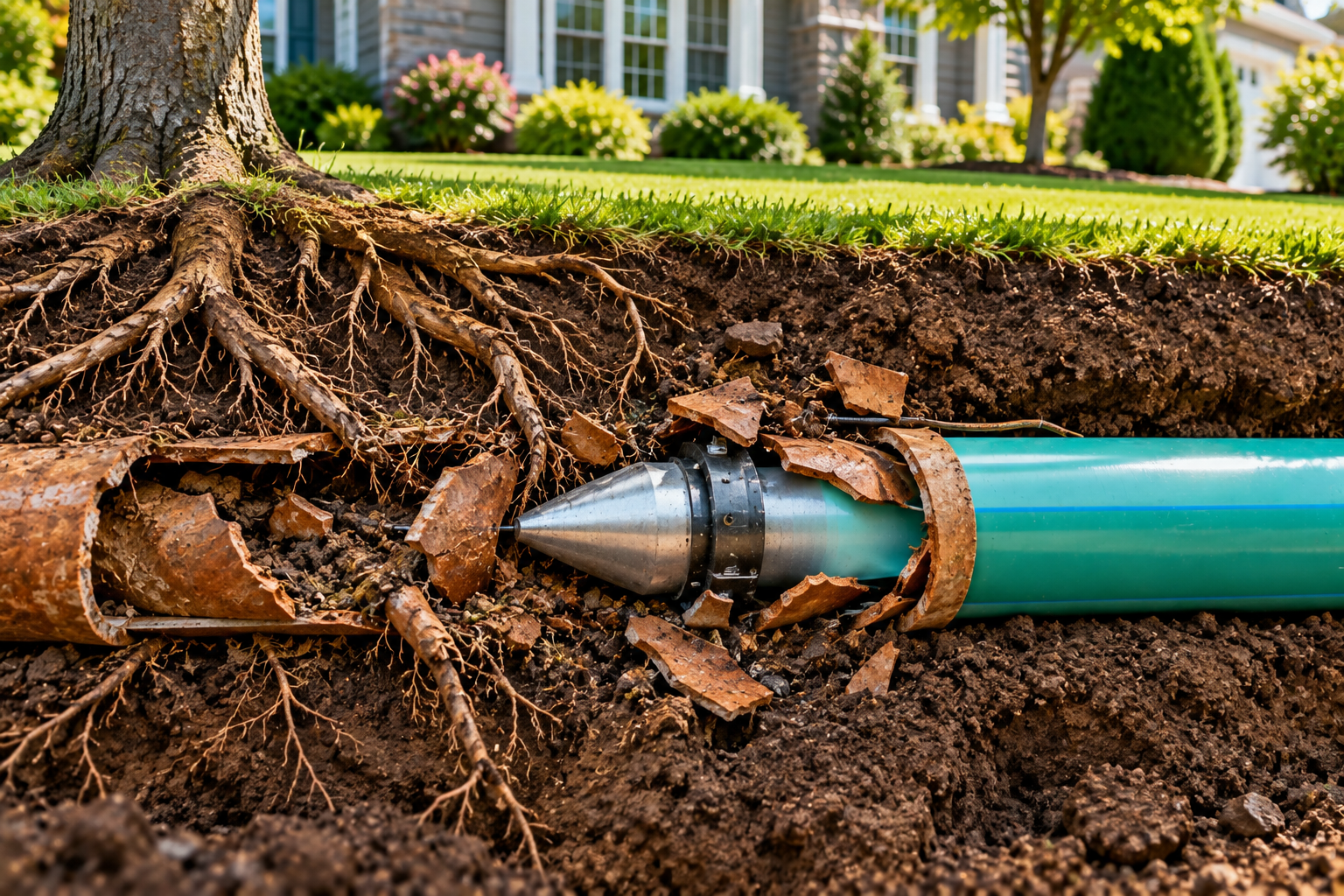
Pipe bursting is a permanent solution for severely damaged sewer laterals. Unlike pipe lining, which creates a new pipe within the old one, pipe bursting completely replaces the host pipe. Consequently, it’s an ideal solution for pipes that are collapsed, have significant offsets, or require an increase in diameter for better flow. The technique uses hydraulic power to fragment the old pipe (made of clay, cast iron, or concrete) and push the pieces into the surrounding soil. As a result, a clear path is made for the new pipe.
This method is a cornerstone of modern trenchless sewer repair because it delivers a brand-new, long-lasting pipe with minimal surface disruption. Instead of a long trench, technicians only need to dig small access pits at the start and end of the damaged pipe section. This makes it a faster, cleaner, and often more cost-effective solution when you factor in the cost of landscape restoration.
The Step-by-Step Pipe Bursting Process
The pipe bursting process is a highly engineered procedure that requires specialized equipment and expert technicians. While the specifics can vary slightly, the core steps remain consistent. Understanding them demystifies the technology and highlights its efficiency.
- Initial Camera Inspection: Before any work begins, a crucial first step is a thorough sewer camera inspection. A high-resolution camera is fed through the line to accurately diagnose the problem, locate the damage, and confirm that pipe bursting is the appropriate solution. This inspection ensures there are no unforeseen complications.
- Creating Access Points: Next, technicians dig two small pits: an entry pit (or launching pit) and an exit pit (or receiving pit). These are strategically placed at either end of the pipe section being replaced. These pits are the only significant digging required for the entire process.
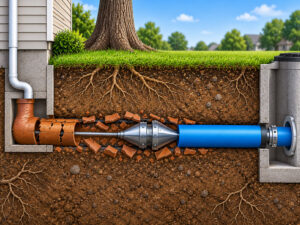
- Inserting the Bursting Head and New Pipe: A heavy-duty steel cable is fed through the old pipe, from the exit pit to the entry pit. At the entry pit, a cone-shaped expander, known as the ‘bursting head,’ is attached to the cable. Directly behind the head, the new, high-density polyethylene (HDPE) pipe is attached.
- The Bursting and Replacement: A powerful hydraulic ram at the exit pit begins pulling the cable. This action pulls the bursting head through the old pipe. The head’s conical shape applies immense force, fracturing the old pipe and pushing the fragments outward into the soil. Simultaneously, it pulls the new HDPE pipe directly into the path it has just cleared.
- Final Connections and Inspection: Once the new pipe is in place, the bursting head is removed. Technicians then securely connect the new pipe section to the existing sewer system. Finally, another camera inspection is performed to verify the integrity of the new line and ensure all connections are flawless.
Why Choose Pipe Bursting? Key Advantages for Homeowners
Homeowners increasingly choose pipe bursting over traditional methods for several compelling reasons. The benefits extend beyond just avoiding a ruined lawn. Furthermore, the long-term value is significant.
- Minimal Disruption to Your Property: This is the most celebrated advantage. Pipe bursting preserves your lawn, garden, driveway, and patio. The cost and hassle of extensive landscape restoration are completely avoided.
- Durability and Longevity: The new HDPE pipe is a superior material. It is seamless, which eliminates joints that can attract tree roots. Additionally, it’s resistant to corrosion, abrasion, and cracking, giving it a service life of 50-100 years. Authoritative bodies like the Plastics Pipe Institute (PPI) have documented its exceptional durability.
- Improved Flow Capacity: In many cases, it’s possible to pull in a new pipe with the same or even a slightly larger diameter than the old one. This can significantly improve your sewer system’s flow capacity, reducing the risk of future backups.
- Cost-Effectiveness: While the initial technology cost can be comparable to traditional methods, the overall project is often cheaper. When you consider the savings from not having to repair concrete, asphalt, or landscaping, the financial benefits become clear. For more details, exploring a sewer lateral repair cost guide can provide valuable context.
When is Pipe Bursting the Right Solution?
Is pipe bursting always the answer? Not necessarily, but it is the superior choice in many common scenarios. It is particularly effective for pipes that are severely cracked, have shifted or offset joints, are heavily infiltrated by roots, or have partially collapsed. It works on a variety of old pipe materials, including clay tile, cast iron, and non-reinforced concrete. Understanding how does pipe bursting work helps you and your plumbing professional decide if it’s the best fit for your specific problem.
Pipe Bursting vs. Other Trenchless Methods
It’s important to distinguish pipe bursting from CIPP (Cured-in-Place Pipe) lining. CIPP lining involves inserting a resin-saturated liner into the old pipe and curing it to form a new pipe inside the old one. CIPP is excellent for rehabilitating pipes with cracks or small holes but is not suitable for collapsed lines or when an upsize is needed. Pipe bursting, in contrast, provides a completely new, structurally independent pipe.
Understanding the Technology: How Does Pipe Bursting Work Mechanically?
The mechanical process is a marvel of engineering. The hydraulic rams used can generate immense pulling force, often between 30 and 100 tons. This power is what allows the bursting head to make short work of old, brittle pipes. The expander head itself is designed not just to break the pipe but to compact the surrounding soil, creating a stable tunnel for the new pipe. The HDPE pipe is fused into one continuous length before being pulled, ensuring there are no weak points. This method is recognized by government agencies like the EPA as an effective and environmentally friendlier approach to infrastructure renewal. The entire operation showcases how targeted force can solve a massive problem with surgical precision, which is the core of how does pipe bursting work.
Key Takeaways: Your Pipe Bursting Summary
Ultimately, pipe bursting represents a significant advancement in plumbing and sewer repair. It offers a robust, long-term solution that protects the value and appearance of your property. By replacing a damaged pipe instead of just repairing it, you are investing in decades of worry-free performance. The process is fast, effective, and minimizes the disruption to your daily life. If you are dealing with a persistent or severe sewer line issue, pipe bursting is a solution you should seriously consider.
Ready to solve your sewer problems without destroying your yard? Contact a professional team to discuss if pipe bursting is the right choice for your home.
Related Posts